White balance (WB) is the process of removing unrealistic color casts, so that objects which appear white in person are rendered white in your photo. Proper camera white balance has to take into account the "color temperature" of a light source, which refers to the relative warmth or coolness of white light. Our eyes are very good at judging what is white under different light sources, however digital cameras often have great difficulty with auto white balance (AWB). An incorrect WB can create unsightly blue, orange, or even green color casts, which are unrealistic and particularly damaging to portraits. Performing WB in traditional film photography requires attaching a different cast-removing filter for each lighting condition, whereas with digital this is no longer required. Understanding digital white balance can help you avoid color casts created by your camera's AWB, thereby improving your photos under a wider range of lighting conditions.
Normally our eyes compensate for lighting conditions with different color temperatures. A digital camera needs to find a reference point which represents white. It will then calculate all the other colors based on this white point. For instance, if a halogen light illuminates a white wall, the wall will have a yellow cast, while in fact it should be white. So if the camera knows the wall is supposed to be white, it will then compensate all the other colors in the scene accordingly.
Showing posts with label Settings. Show all posts
Showing posts with label Settings. Show all posts
Tuesday, September 9, 2008

Tuesday, August 26, 2008
Night/Low-Light Photography: Experiment with different settings
Once you're comfortable with your camera's manual controls (or even with its built-in night mode), you can further explore the challenge of low-light photography by trying some of the following:
Use reflections to your advantage
Some of the most spectacular night photography involves the use of reflections. Reflections not only give you more light to work with, but they also add visual interest to your photographs. Look for reflections on bodies of water, snow banks, windows, mirrors, cars, etc.
Blaze a trail
Create trails of light with long shutter times and small apertures. Use your camera's longest shutter time or your camera's bulb mode (if available). Bulb mode lets you keep your shutter indefinitely on some cameras, or for periods of up to 5 or 10 minutes, on others.
Use a tripod
A great way to improve your night photography is to use a tripod. A tripod will keep your camera steady and will give you further control over exposure by reducing camera shake, thus enabling you to keep your shutter open longer. Tripods come in several varieties, including table-top models that you can fit in your pocket.
If your camera has a remote control, use it in conjunction with your tripod to further eliminate camera shake.
Look for light
Even at night, you're surrounded by light, especially in cities. Streetlights, traffic lights, neon signs, office interiors and car headlights are just some of the types of light you'll find at night. And let's not forget moonlight and starlight. Dealing with the variety of available light is one of the challenges of shooting at night. With practice, you'll learn what settings work best with specific types of light.
Use reflections to your advantage
Some of the most spectacular night photography involves the use of reflections. Reflections not only give you more light to work with, but they also add visual interest to your photographs. Look for reflections on bodies of water, snow banks, windows, mirrors, cars, etc.
Blaze a trail
Create trails of light with long shutter times and small apertures. Use your camera's longest shutter time or your camera's bulb mode (if available). Bulb mode lets you keep your shutter indefinitely on some cameras, or for periods of up to 5 or 10 minutes, on others.
Put your camera on a tripod and position yourself at the corner of a busy intersection or on an overpass over a busy highway. Press the shutter release and wait. As cars pass by, they will create streaks of light that travel across your picture.
Monday, August 25, 2008
Depth of Field : Sharpness of a photograph
Depth of field (DOF) is the portion of a scene that appears sharp in the image. Although a lens can precisely focus at only one distance, the decrease in sharpness is gradual on either side of the focused distance, so that within the DOF, the unsharpness is imperceptible under normal viewing conditions.
For some images, such as landscapes, a large DOF may be appropriate, while for others, such as portraits, a small DOF may be more effective.
The DOF is determined by the subject distance (that is, the distance to the plane that is perfectly in focus), the lens focal length, and the lens f-number (relative aperture). Except at close-up distances, DOF is approximately determined by the subject magnification and the lens f-number. For a given f-number, increasing the magnification, either by moving closer to the subject or using a lens of greater focal length, decreases the DOF; decreasing magnification increases DOF. For a given subject magnification, increasing the f-number (decreasing the aperture diameter) increases the DOF; decreasing f-number decreases DOF.
For some images, such as landscapes, a large DOF may be appropriate, while for others, such as portraits, a small DOF may be more effective.
The DOF is determined by the subject distance (that is, the distance to the plane that is perfectly in focus), the lens focal length, and the lens f-number (relative aperture). Except at close-up distances, DOF is approximately determined by the subject magnification and the lens f-number. For a given f-number, increasing the magnification, either by moving closer to the subject or using a lens of greater focal length, decreases the DOF; decreasing magnification increases DOF. For a given subject magnification, increasing the f-number (decreasing the aperture diameter) increases the DOF; decreasing f-number decreases DOF.
Thursday, August 14, 2008
Shutter Speed
In photography, shutter speed is the length of time a shutter is open; the total exposure is proportional to this exposure time, or duration of light reaching the film or image sensor.
Factors that affect the total exposure of a photograph include the scene luminance, the aperture size (f-number), and the exposure time (shutter speed); photographers can trade off shutter speed and aperture by using units of stops. A stop up and down on each will halve or double the amount of light regulated by each; exposures of equal exposure value can be easily calculated and selected. For any given total exposure, or exposure value, a fast shutter speed requires a larger aperture (smaller f-number). Similarly, a slow shutter speed, a longer length of time, can be compensated by a smaller aperture (larger f-number).
Slow shutter speeds are often used in low light conditions, extending the time until the shutter closes, and increasing the amount of light gathered. This basic principle of photography, the exposure, is used in film and digital cameras, the image sensor effectively acting like film when exposed by the shutter.
Shutter speed is measured in seconds. A typical shutter speed for photographs taken in sunlight is 1/125th of a second. In addition to its effect on exposure, shutter speed changes the way movement appears in the picture. Very short shutter speeds are used to freeze fast-moving subjects, for example at sporting events. Very long shutter speeds are used to intentionally blur a moving subject for artistic effect.


Factors that affect the total exposure of a photograph include the scene luminance, the aperture size (f-number), and the exposure time (shutter speed); photographers can trade off shutter speed and aperture by using units of stops. A stop up and down on each will halve or double the amount of light regulated by each; exposures of equal exposure value can be easily calculated and selected. For any given total exposure, or exposure value, a fast shutter speed requires a larger aperture (smaller f-number). Similarly, a slow shutter speed, a longer length of time, can be compensated by a smaller aperture (larger f-number).
Slow shutter speeds are often used in low light conditions, extending the time until the shutter closes, and increasing the amount of light gathered. This basic principle of photography, the exposure, is used in film and digital cameras, the image sensor effectively acting like film when exposed by the shutter.
Shutter speed is measured in seconds. A typical shutter speed for photographs taken in sunlight is 1/125th of a second. In addition to its effect on exposure, shutter speed changes the way movement appears in the picture. Very short shutter speeds are used to freeze fast-moving subjects, for example at sporting events. Very long shutter speeds are used to intentionally blur a moving subject for artistic effect.

Hight Shutter Speed

Low Shutter Speed
I shot these pics during Shrikhand Trek in Himachal Pradesh.
I shot these pics during Shrikhand Trek in Himachal Pradesh.
Thursday, June 12, 2008
What is Aperture in Cameras?
In optics, an aperture is a hole or an opening through which light is admitted. More specifically, the aperture of an optical system is the opening that determines the cone angle of a bundle of rays that come to a focus in the image plane. The aperture determines how collimated the admitted rays are, which is of great importance for the appearance at the image plane.
F-STOPS:
* F-stop: Focal length/Diameter of the selected aperture.
* F-stop: Bigger the number smaller the aperture, smaller the number bigger the aperture.
* With every opening of aperture by one full f-stop, amount of light coming in the camera becomes twice of the previous stop.
* Reducing the aperture size increases the depth of field, which describes the extent to which subject matter lying closer than or farther from the actual plane of focus appears to be in focus.
* In general, the smaller the aperture (the larger the number), the greater the distance from the plane of focus the subject matter may be while still appearing in focus.
Aperture priority is a semi-automatic shooting mode used in cameras. It allows the photographer to choose an aperture setting and allow the camera to decide the shutter speed and sometimes ISO sensitivity for the correct exposure. This is sometimes referred to as Aperture Priority Auto Exposure, A mode, Av mode, or semi-auto mode.
Prime lenses have a fixed focal length (FFL) and large aperture and are favored by professionals, especially by photojournalists who often work in dim light, have no opportunity to introduce supplementary lighting, and need to capture fast breaking events.
Zoom lenses typically have a maximum aperture (minimum f-number) of f/2.8 to f/6.3 through their range. A very fast zoom lens will be constant f/2.8 or f/2, which means the relative aperture will stay the same throughout the zoom range. A more typical consumer zoom will have a variable relative aperture, since it is harder and more expensive to keep the effective aperture proportional to focal length at long focal lengths; f/3.5 to f/5.6 is an example of a common variable aperture range in a consumer zoom lens.
The amount of light captured by a lens is proportional to the area of the aperture, equal to:
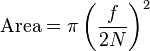
- Where f is focal length and N is the f-number.
The focal length value is not required when comparing two lenses of the same focal length; a value of 1 can be used instead, and the other factors can be dropped as well, leaving area proportion to the reciprocal square of the f-number N..
If two cameras of different format sizes and focal lengths have the same angle of view, and the same aperture area, they gather the same amount of light from the scene. The relative focal-plane illuminance, however, depends only on the f-number N, independent of the focal length, so is less in the camera with the larger format, longer focal length, and higher f-number.
Wednesday, June 11, 2008
Controlling the photographic exposure and rendering
Camera controls are inter-related. The total amount of light reaching the film plane (the "exposure") changes with the duration of exposure, aperture of the lens, and focal length of the lens (which changes as the lens is zoomed). Changing any of these controls alters the exposure. Many cameras may be set to adjust most or all of these controls automatically. This automatic functionality is useful in many situations, and in most situations to occasional photographers.
The duration of an exposure is referred to as shutter speed, often even in cameras that don't have a physical shutter, and is typically measured in fractions of a second. Aperture is expressed by an f-number or f-stop (derived from focal ratio), which is proportional to the ratio of the focal length to the diameter of the aperture. If the f-number is decreased by a factor of , the aperture diameter is increased by the same factor, and its area is increased by a factor of 2. The f-stops that might be found on a typical lens include 2.8, 4, 5.6, 8, 11, 16, 22, 32, where going up "one stop" (using lower f-stop numbers) doubles the amount of light reaching the film, and stopping down one stop halves the amount of light.
The duration of an exposure is referred to as shutter speed, often even in cameras that don't have a physical shutter, and is typically measured in fractions of a second. Aperture is expressed by an f-number or f-stop (derived from focal ratio), which is proportional to the ratio of the focal length to the diameter of the aperture. If the f-number is decreased by a factor of , the aperture diameter is increased by the same factor, and its area is increased by a factor of 2. The f-stops that might be found on a typical lens include 2.8, 4, 5.6, 8, 11, 16, 22, 32, where going up "one stop" (using lower f-stop numbers) doubles the amount of light reaching the film, and stopping down one stop halves the amount of light.
Exposures can be achieved through various combinations of shutter speed and aperture. For example, f/8 at 8 ms (=1/125th of a second) and f/5.6 at 4 ms (=1/250th of a second) yield the same amount of light. The chosen combination has an impact on the final result. In addition to the subject or camera movement that might vary depending on the shutter speed, the aperture (and focal length of the lens) determine the depth of field, which refers to the range of distances from the lens that will be in focus. For example, using a long lens and a large aperture (f/2.8, for example), a subject's eyes might be in sharp focus, but not the tip of the nose. With a smaller aperture (f/22), or a shorter lens, both the subject's eyes and nose can be in focus. With very small apertures, such as pinholes, a wide range of distance can be brought into focus.
Photographic Controls
Photographers control the camera and lens to "expose" the light recording material (such as film) to the required amount of light to form a "latent image" (on film) or "raw file" (in digital cameras) which, after appropriate processing, is converted to a usable image. Modern digital cameras replace film with an electronic image sensor based on light-sensitive electronics such as charge-coupled device (CCD) or complementary metal-oxide-semiconductor (CMOS) technology. The resulting digital image is stored electronically, but can be reproduced on paper or film.
Now we start discussing different controls in cameras which give flexibility to photographers to capture a particular view conveniently....
- Aperture of the lens
- Shutter speed
- ISO speed
- White balance
- Auto Focus Point
- Focal Length
- Filters & Scrims
.........
Now we start discussing different controls in cameras which give flexibility to photographers to capture a particular view conveniently....
- Aperture of the lens
- Shutter speed
- ISO speed
- White balance
- Auto Focus Point
- Focal Length
- Filters & Scrims
.........
Subscribe to:
Posts (Atom)
Popular Posts

LinkWithin
